This qualification provides learners with the skills and knowledge required to work in the cabinet making and furnishing industry, producing and installing a wide range of timber and manufactured board products for residential, commercial and industrial applications. The qualification includes core units of competency that develop essential industry skills, together with specialist cabinet making and timber technology competencies required to manufacture, assemble, finish and install cabinetry and furniture products.
Graduates of this qualification apply technical knowledge and practical skills to interpret plans, prepare production documentation, operate woodworking machinery, manufacture cabinetry components, apply decorative finishes, and install completed products in accordance with industry standards and workplace requirements.
Occupational titles may include:
This qualification is suitable for individuals seeking employment within the cabinet making, joinery and furnishing industries and may also provide a pathway to higher-level qualifications in building, construction, furniture design and manufacturing. It is also suitable as an Australian apprenticeship pathway for learners entering the cabinet making trade.
This qualification is delivered through a combination of:
Students are required to attend scheduled classroom sessions, practical workshop training, and complete all assessment activities in accordance with the course requirements. Practical training is conducted in a simulated workplace environment using industry-standard tools, equipment and materials to ensure students develop the practical skills and knowledge expected by the cabinet making and furnishing industry.
Supplementary classes may be scheduled where required due to public holidays, missed classes, or reassessment requirements.
Students are also expected to undertake approximately 5 hours of independent self-study each week to reinforce classroom learning, complete research activities, prepare for assessments, and review course
This qualification reflects the skills and knowledge required to work in the cabinet making and furnishing industry as a:
Career opportunities may exist within residential, commercial and industrial cabinet making businesses, joinery manufacturers, furniture production facilities, shopfitting companies, kitchen and bathroom manufacturers, and custom timber product workshops.
Students who successfully complete this qualification may progress to:
Additional pathway opportunities may be available depending on individual career goals, industry requirements, and higher education admission criteria. Graduates may also choose to undertake specialised training in cabinet making, joinery, furniture design, shopfitting, building, or related construction and manufacturing disciplines.
All fees are quoted in Australian Dollars (AUD).
Please refer to the Student Handbook and Fees and Refund Policy for detailed information regarding fees, charges, and refunds.
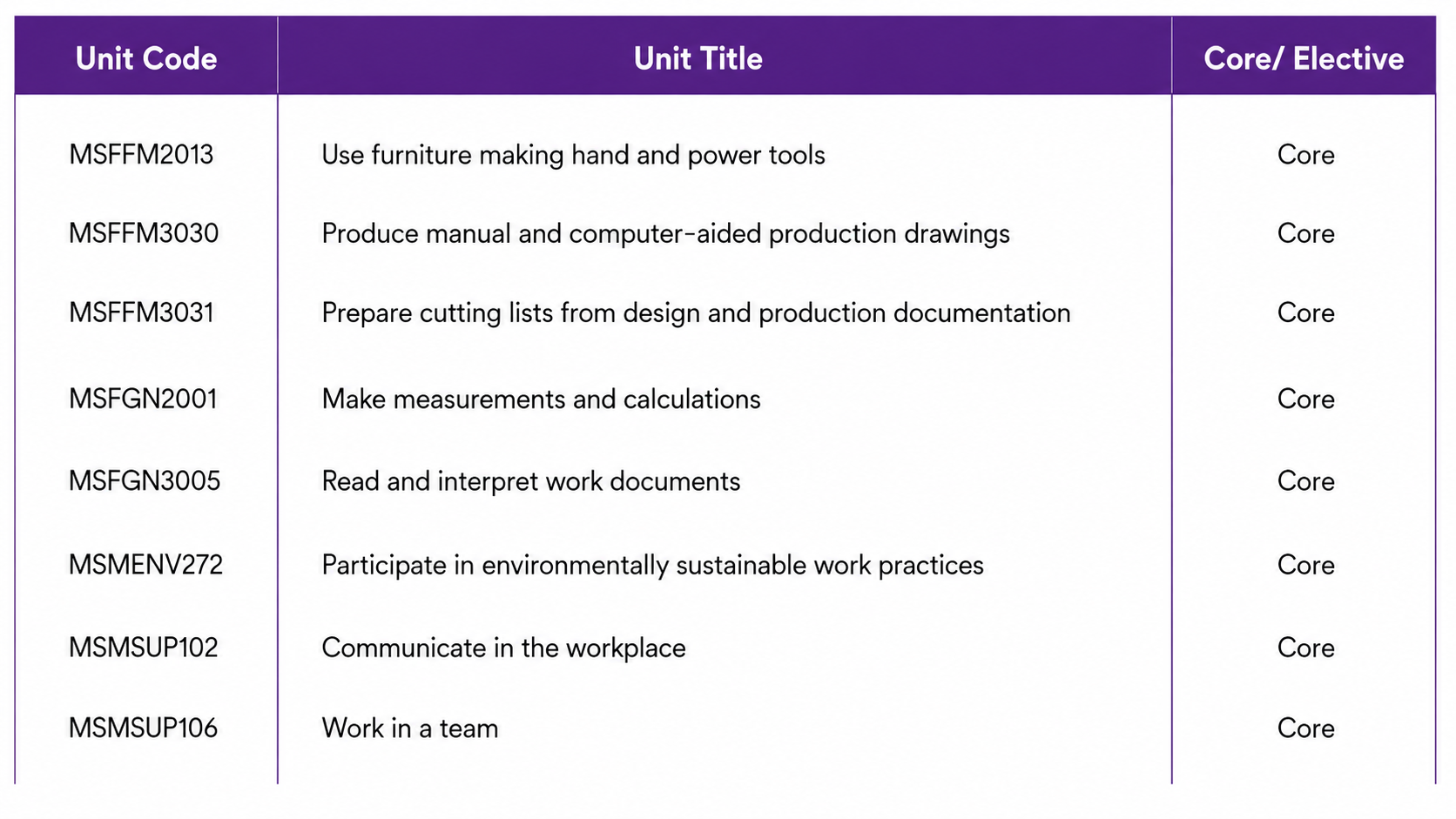
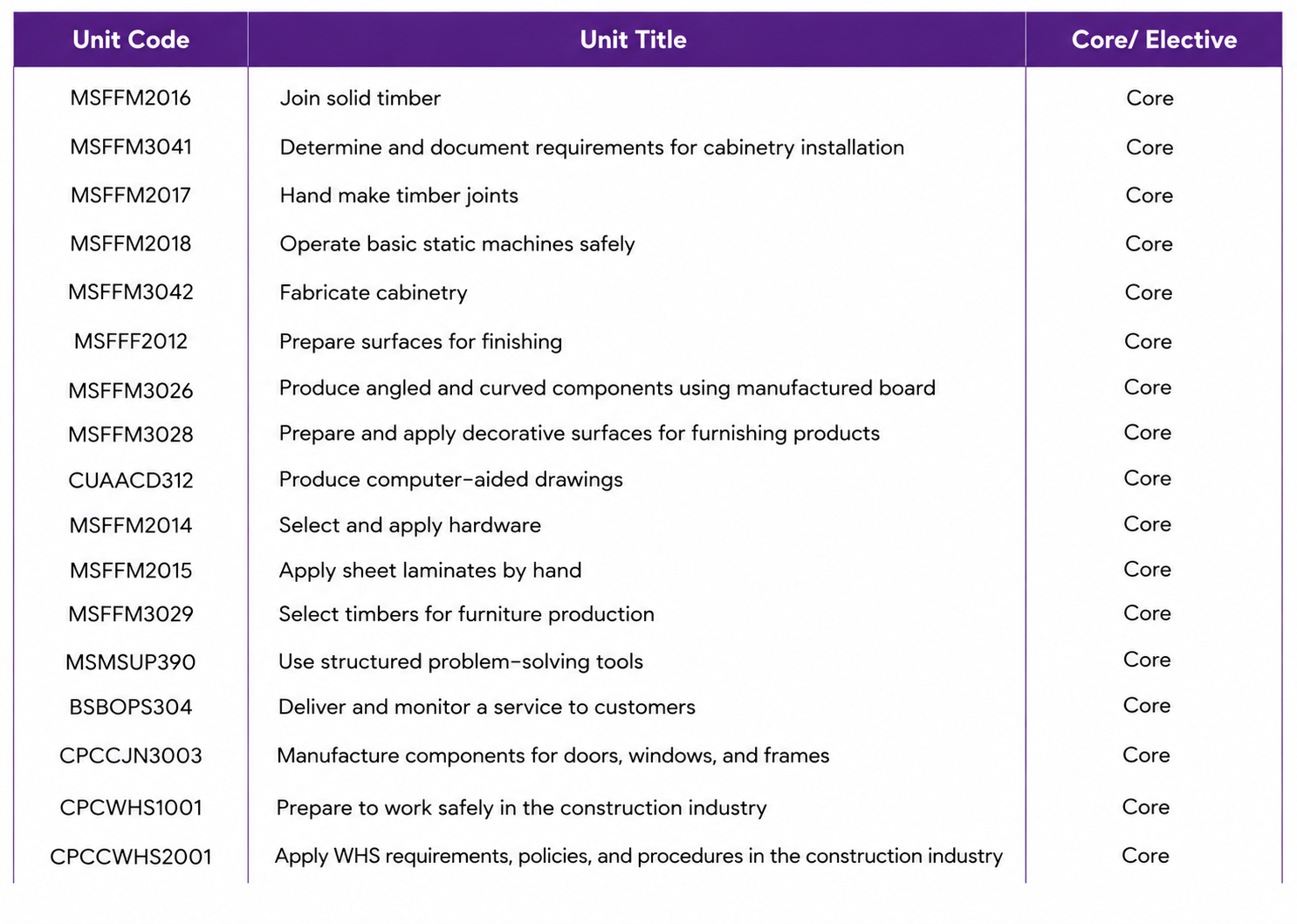
To achieve the qualification MSF30322 Certificate III in Cabinet Making and Timber Technology, students must successfully complete the following units of competency.
IELTS Overall Band Score of 6.0; or
An equivalent recognised English language test score (e.g. PTE Academic or Oxford English Test).
English language evidence may also be demonstrated through previous studies completed in English, subject to Lotus College’s assessment requirements.
All applicants are required to complete a Language, Literacy, Numeracy and Digital Literacy (LLND) assessment prior to enrolment to identify any support needs and ensure they have the capability to successfully complete the course.
Students must be physically capable of undertaking practical cabinet making and timber technology activities, including:
Students should possess an appropriate level of physical fitness, manual dexterity, and hand-eye coordination to safely undertake the practical requirements associated with cabinet making and timber technology.
Students must wear appropriate Personal Protective Equipment (PPE) during all practical training and workshop activities.
Students must comply with all workplace health and safety (WHS) requirements, safe operating procedures, and trainer instructions during practical training sessions. All workshop activities must be undertaken using industry-standard equipment and in accordance with relevant workplace safety legislation and manufacturer operating instructions. Failure to comply with safety requirements or the correct use of PPE may result in students being excluded from practical activities until the appropriate safety requirements are met.